How to get rid of wasps around a Boise home
Most wasp problems around a Boise home can be fixed with a garden hose, the right spray and good timing. A few cannot. This guide covers which wasp you have, the DIY steps University of Idaho Extension recommends, and the point where a licensed local pro is the smarter call.
In this guide
Which wasp is at your house, and why it matters
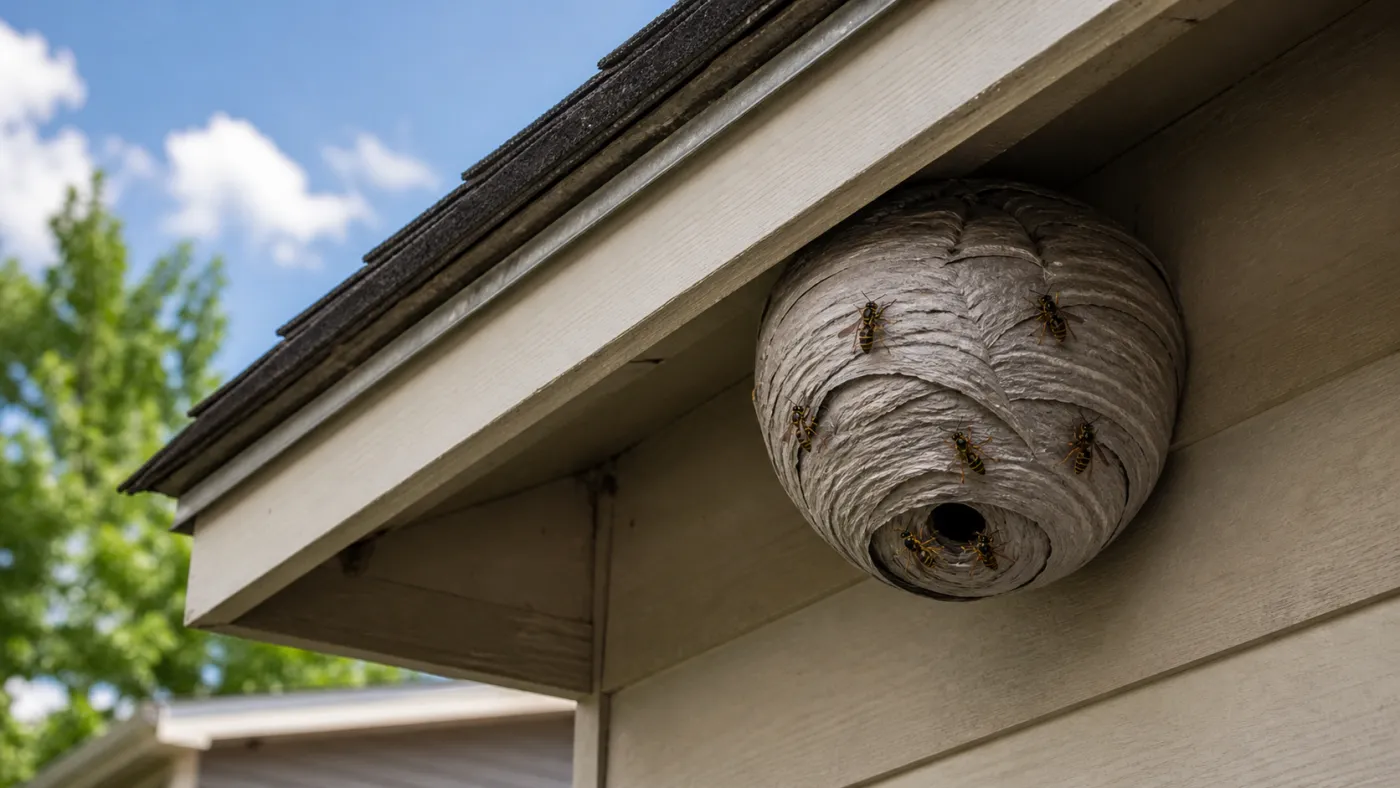
The wasp around your Boise home is almost certainly a European paper wasp, a western yellowjacket or a bald-faced hornet, and each one gets handled differently. University of Idaho Extension bulletin BUL 852, by entomologist Edward Bechinski and colleagues, calls the European paper wasp Idaho's most commonly encountered stinging pest. It is slim and long-legged and hangs an open, umbrella-shaped comb under eaves, inside porch lights and in the grill lid. Fairly docile. It stings when you grab the nest, not because you walked past.
Western yellowjackets are the ones that ruin a barbecue. The same bulletin names them the state's most abundant yellowjacket: stocky, shiny, nesting out of sight in old rodent burrows and cracks in retaining walls. Bald-faced hornets, the big black-and-white wasps with the gray football nest, are less of a sting threat, Idaho Extension says, because they hunt live insects and nest high. The German yellowjacket is the one that moves into wall voids and attics.
What waiting until late summer actually looks like
Waiting on a wasp nest in Boise rarely hurts the house itself, but it lets one queen's April project grow into a colony of hundreds or thousands by late August, and you tend to meet it at the worst moment. Picture the last Saturday of August. You push the mower along the back fence, over a small hole you took for an old vole run. Idaho Extension is specific about what happens next: vibration over an underground nest sets off the attack. One bump on your ankle. Then a rising buzz at shin height, and they are on your calves and in your hair, each one able to sting again and again. You run, and agitated yellowjackets may chase you several hundred feet.
The quiet version is worse for the house. You spot wasps slipping in and out of a gap where the siding meets the soffit, so on Sunday you do the tidy thing and caulk it shut. Monday night one is crawling across the kitchen ceiling. By Tuesday a dozen are bumping the living room window. Idaho Extension warns about exactly this: trapped workers chew through interior walls into the house. And once that colony dies, the dead larvae in the cavity rot with a smell the bulletin calls intolerable.
Then there are the stings. BUL 852 puts whole-body allergic reactions to sting venom at 1 to 3 percent of people, and nobody wears a label saying who is in that group. If a nest sits by the door the kids use, or wasps are already inside, our emergency pest control page covers what to do in the first hour.
DIY wasp control that works in the Treasure Valley
DIY wasp control around a Boise home works best in spring and after dark. In April and May a nest is one queen and a golf-ball comb, and a hard blast from the hose ends it. Wait until July and the same job needs a spray can, goggles and a plan. The playbook, per University of Idaho Extension:
| Situation | What to do | Why it works |
|---|---|---|
| Starter nest under an eave, April to May | Hose it off. Paper wasp combs any time the queen is away; enclosed hornet or yellowjacket starters only on a cool night | One queen, no workers yet, and cold wet weather makes rebuilding hard |
| Small, visible nest in summer | After dark, soak it with a jet spray labeled for outdoor wasp nests. Flashlight on the ground to the side, heavy clothes, eye protection; scrape the nest off after two days | Most workers are home at night, and foragers that return later hit the residue |
| Yellowjackets working the patio | Hang 4 to 6 heptyl butyrate traps around the yard edge, at least 20 feet from people, never on the deck itself | The lure strongly attracts western yellowjackets; it will not catch paper wasps or wipe out a colony |
| A ground nest you can locate | Bait with cat food, follow a forager home, mark the hole, treat after dark with a labeled liquid | Yellowjackets fly straight back to the nest, and spraying blind gets you stung |
| All summer, every yard | Lid the trash, pick up fallen fruit, fix dripping hoses, keep pet food and open sodas inside | Late-season yellowjackets hunt sugar, protein and puddled water |
Three hard no's from Idaho Extension: no gasoline or kerosene in a ground nest (fire and groundwater risk), no boiling water or flooding (the comb often sits off to the side and survives), and no plugging an entrance instead of treating it. Yellowjackets love old rodent holes, so a lawn full of them is also a job for rodent control. One honest aside: a nest nobody walks past can be left alone. The workers die with the first freeze.
When DIY is not enough: five signs
A wasp problem is past DIY when the nest is inside the structure, large, hard to reach or near someone who reacts badly to stings, the same cases University of Idaho Extension hands to professionals. Any one is enough:
- Wasps are going in and out of your siding, soffit or attic vent. That is a wall-void or attic nest, and the dead nest has to come out afterward or the wall starts to smell.
- You found a busy hole in the lawn in August or September. A late-summer ground colony can hold thousands of workers, and you would be standing on top of it.
- The gray, enclosed nest is bigger than a softball. Idaho Extension says flatly never to knock down, cut and bag, or otherwise disturb large nests.
- You cannot see the entrance, or you need a ladder to reach it. The bulletin says not to spray unless you can see the entrance, and a ladder is a terrible place to take the first sting.
- Someone in the house has reacted badly to a sting before. Then the nest by the door is a medical risk, not a weekend project.
If that list describes your yard, set the can down and make one phone call instead. Call (208) 999-4091 and we connect you with a licensed local provider who serves Boise and the Treasure Valley, hears where the nest is, and gives you a price on the call with no obligation to book. Same-day and 24/7 emergency services are subject to provider participation, location, technician availability, and demand. Availability is not guaranteed and may vary by market and appointment capacity.
What a pro does differently, and what it typically costs
Professional wasp removal differs from DIY mainly in reach and cleanup. The technician identifies the species, finds every entrance, and uses dusts that travel through a wall void instead of coating the doorway. Idaho Extension notes that vacuuming out live nests works where insecticides cannot be used, and calls it too hazardous for homeowners. Our wasp and hornet nest removal page walks through the method nest by nest.
Price depends on where the nest is and how hard it is to reach, so treat any figure as a typical market range, not a quote. Our Boise pest control cost guide lists the nest removal range HomeGuide reports; the provider sets the real number.
The reassuring part: wasps are one of the most fixable pests in Boise. Every colony starts from scratch in spring, so a hose in April, lids on the trash in August and one call for the nest you should not touch is usually the whole story. The wasps keep the foothills and the canal banks. You get the patio back.
Wasp questions from Boise homeowners
Do wasps come back to the same nest every year in Boise?
No. University of Idaho Extension explains that yellowjackets, bald-faced hornets and paper wasps build a brand-new nest each spring and never reuse an old one, because only mated queens survive the winter, sheltering under loose bark or in weedy ground cover. Queens do favor the same kind of sheltered spot, so eaves that hosted a nest this year are worth checking in April. Knocking down an empty nest is tidy but does not change next year's numbers.
How do I tell a paper wasp from a yellowjacket?
Paper wasps are slim and long-legged, with legs that dangle in flight, and they build open, umbrella-shaped combs with the cells visible from below. Yellowjackets are stockier and shinier, nest out of sight in the ground or inside walls, and scavenge meat and sweet drinks in late summer. University of Idaho Extension rates the European paper wasp as the state's most commonly encountered stinging pest, but yellowjackets defend their nests far more aggressively.
Do yellowjacket traps work in Boise?
Yellowjacket traps cut down the foragers bothering your patio, but they do not eliminate colonies. University of Idaho Extension recommends 4 to 6 traps around the yard edge at least 20 feet from people, notes that heptyl butyrate lures strongly attract the western yellowjacket, Idaho's most abundant species, and points out that workers forage several hundred yards from the nest. Traps do not catch paper wasps at all.
When does a wasp sting need medical care?
University of Idaho Extension advises getting medical help right away if the person is stung on the head, neck or inside the mouth, is stung several times, was stung within the previous week, is very young or very old, has trouble breathing or swallowing or feels dizzy, develops hives spreading over the body, or has a known sting allergy. Trouble breathing is a 911 call. For an ordinary sting, washing with soap and an ice compress are the usual first steps.
Wasps going into the wall? That nest is a job for a pro.
Get a free, no-obligation quote from a licensed Boise-area pest control pro. It takes under a minute.