Hobo spider vs house spider in Idaho: how to tell
You cannot confirm a hobo spider by eye, but you can rule one out in about five seconds. Check the legs: bands or rings mean it is not a hobo. Plain tan legs mean maybe, and only a microscope settles it. Here is what that means for your Boise house, and what actually deserves your worry.
In this guide
The short answer: a leg check rules out, a microscope rules in
The hobo spider and the common house spiders of the Treasure Valley are close cousins, all funnel weavers in the family Agelenidae, and they look almost identical to the naked eye. Brown body, long hairy legs, a chevron pattern on the abdomen, a fast sprint across the basement floor. Every one of them.
The one feature you can use at home is the legs. Utah State University Extension notes that hobo spiders do not have dark bands on their legs, while their look-alikes usually do. So banded legs clear the suspect. Plain legs do not convict it. The same Utah State University Extension guidance says a sure identification needs magnification, typically checking whether the male's palp carries two prongs (hobo) or one (domestic and giant house spiders). That is lab work, not kitchen-counter work.
And the stakes of the hobo question are smaller than the internet suggests. The Pacific Northwest Pest Management Handbook says recent research found hobo spider bites no more dangerous than most other spider bites, and that the U.S. Centers for Disease Control removed the species from its list of poisonous spiders. University of Idaho Extension bulletin BUL 1094 names the western black widow as the only Idaho spider of real medical importance.
What guessing wrong can cost you
The real danger in the hobo spider debate is the attention it steals from the things that can actually hurt you. Here is how that plays out in a Boise house.
It is late August. You flip on the basement light and a brown spider the size of a half dollar bolts along the baseboard. You smash it with a shoe, squint at the smear, and decide: hobo. You spend the evening reading bite horror stories and bomb the basement. Meanwhile, out in the garage, behind the paint cans you have not touched since spring, a glossy black female with a red hourglass is guarding two egg sacs, and nobody is looking there because the scary spider already got caught.
Two weeks later your son shows you a red, hot bump on his calf. Everybody in the house says the same thing: hobo bite. So you ice it and wait. The CDC warns that people sometimes confuse MRSA skin infections with spider bites, and a staph infection does not get better with ice. It spreads. That is the honest worst case here: not a monster spider, but a missed widow and a misread wound. Draw a pen line around any red spot that worries you. If the redness grows past the line, or a fever shows up, that is a doctor visit tonight, not a spider problem.
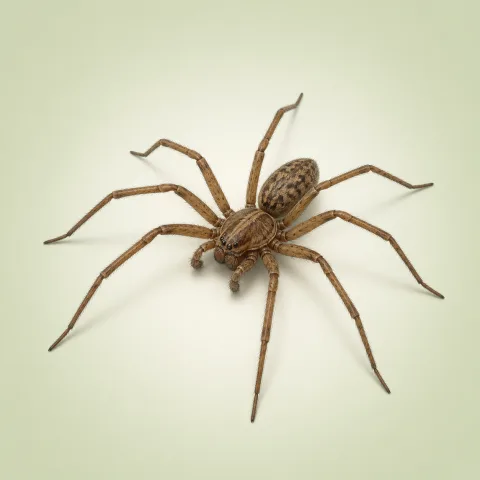
Hobo spider, giant house spider and barn funnel weaver side by side
The three funnel weavers most often confused in Treasure Valley homes differ mainly in leg markings, and even that is a clue rather than a verdict.
| Feature | Hobo spider | Giant house spider | Barn funnel weaver (domestic house spider) |
|---|---|---|---|
| Legs | One even shade, no bands | Often faint bands or mottling | Clearly banded, easiest to rule out |
| Body | Brown to gray-brown, chevrons on abdomen | Brown, chevrons on abdomen | Paler, mottled gray-brown |
| Male palps (microscope) | Two prongs | One prong | One prong |
| Where you meet it in Boise | Basement floors, window wells, rock gardens | Basements, garages, bathtubs | Garages, sheds, corners of outbuildings |
| Medical concern | Removed from the CDC poisonous list | None of note | None of note |
Hobo spider size overlaps with its cousins, too. The Pacific Northwest Pest Management Handbook puts the hobo body at 3/8 to 5/8 inch, and 1 to 1.75 inches with the legs, so size alone tells you nothing useful.
What you can do yourself, starting tonight
Hobo spider control in Boise is the same as control for any funnel weaver: catch, identify, trap, and seal. None of it needs a chemical.
- Catch, don't squash. A glass over the spider and a card underneath beats a shoe every time, because a flattened spider cannot be identified by anyone.
- Do the leg check. Bands mean house spider, done, go to bed. Plain legs mean drop it in a small jar of rubbing alcohol for a University of Idaho Extension office, such as the Ada County office in Boise.
- Put sticky traps along the baseboards. Utah State University Extension recommends them for funnel weavers, placed where kids and pets cannot reach. Wandering males run along walls and walk straight in.
- Seal the ground floor. Silicone caulk in foundation cracks, weather-stripping under doors, screens on crawl-space vents. Hobos are ground runners, so the lowest gaps matter most.
- Clear the foundation line. Pull firewood, landscape timbers and loose rock back from the siding, and empty the window wells. That is where the funnel webs live.
- Glove up and look in the garage. This is the step that actually protects your family, because it is where the black widow lives.

When DIY is not enough: four signs
A hobo or house spider problem moves past DIY when the spiders keep coming after you have sealed and trapped, or when a widow is part of the picture:
- Sticky traps keep filling for weeks after you sealed the obvious gaps, which points to an entry you cannot find.
- Spiders turn up after the first hard freeze. Wandering season is over, so winter sightings mean an indoor population with an indoor food source.
- You find black widows or egg sacs in the garage, shed or window wells, anywhere the family reaches.
- The webs are in places you should not climb or crawl, like second-story eaves or a tight crawl space.
If any of those sound like your house, the sensible next step is a phone call, not another trap. Call (208) 999-4091 and we connect you with a licensed local provider in Boise, Meridian, Nampa or elsewhere in the Treasure Valley, who can identify what you have and price the job on the call with no obligation. Same-day and 24/7 emergency services are subject to provider participation, location, technician availability, and demand. Availability is not guaranteed and may vary by market and appointment capacity. Our spider control page for Boise explains what that visit usually includes.
The reassuring bottom line
A brown spider in a Boise basement is almost always a harmless funnel weaver, and even a real hobo spider is no longer considered a medical threat. Check the legs, keep the specimen if you are curious, seal the ground floor, and spend your worry on the garage corners where widows hide.
On cost, read every figure as a typical market range, not a quote. One-time spider service in the Treasure Valley commonly runs about $150 to $350, and our Boise pest control cost guide puts that next to other pests. For when these spiders appear and why sightings spike in late summer, see our guide to Boise spider season. Honestly? Most of the time the spider you are staring at is just a lost bachelor looking for a date. Show him the door and get some sleep.
Hobo spider questions from Boise homeowners
Is the hobo spider dangerous in Idaho?
Probably no more than any other house spider. For years the hobo spider was blamed for slow-healing, dying-skin wounds, but later research could not reproduce those results, and the Pacific Northwest Pest Management Handbook notes that the U.S. Centers for Disease Control removed it from its list of poisonous spiders. University of Idaho Extension names the black widow as the only Idaho spider of real medical importance. Any bite that spreads, blisters or comes with fever still deserves a doctor.
How can I tell a hobo spider from a house spider without a microscope?
Look at the legs. Utah State University Extension notes that hobo spiders do not have dark bands on their legs, while the barn funnel weaver and most giant house spiders show rings or mottling. Banded legs rule out a hobo. Plain tan legs only mean it might be one, because Utah State University Extension also says positive identification needs a microscope and an expert, usually by checking the male's palps or the female's reproductive plate.
Where can I get a spider identified in Boise?
Drop the spider in a small jar of rubbing alcohol and take it to a University of Idaho Extension office, such as the Ada County office in Boise. Extension staff can look at it under magnification, which is the only honest way to separate a hobo spider from its look-alike cousins. A licensed pest control provider can also identify spiders during an inspection and tell you what they are feeding on.
Why are hobo spiders showing up in my house in August?
Because the males are out looking for mates. University of Idaho Extension bulletin BUL 871 says the hobo spiders Boise homeowners see running across ground-level floors from mid-July until the first killing frost are mostly mature males wandering in from outdoor webs. A single fast brown spider in the basement in August is a lost traveler, not proof of a nest in the walls.
Not sure what spider you have? Get it identified.
Get a free, no-obligation quote from a licensed Boise-area pest control pro. It takes under a minute.